



Chicken Coop Mobile Systems Make Small Farm Management Easier
Managing a small poultry operation involves far more complexity than most people assume. Feed schedules, sanitation cycles, predator threats, and soil degradation all compete for limited time and labor. A Chicken Coop Mobile system—also called a pastured poultry house or chicken tractor—addresses these compounding challenges by combining portability with automation. Rather than anchoring your flock to a single worn patch of ground, mobile poultry housing lets you rotate birds systematically across pasture, dramatically improving hygiene, soil fertility, and flock productivity in one structural decision.
Understanding Mobile Chicken Coop Systems: Key Features and Benefits
Mobile Chicken Coops today are much more advanced than the simple wheeled frames of the past. Today's commercial-grade units come with solar power, automatic food lines, nipple drinking systems, and strong galvanized steel construction, all in one package that can be moved.
What Sets a Quality Mobile Unit Apart
The mobile chicken coop from Huabang Smart is made with an aluminum-zinc coated mesh panel frame that has been hot-dip galvanized and given a 275g/m² zinc covering. The normal size is 15 meters by 5 meters by 2.8 meters, which can easily fit 700 to 900 birds per unit. A 5 cm raised center ridge improves airflow inside, lowering heat stress and ammonia buildup without using mechanical ventilation, which is a big plus in warmer U.S. climates.
The unit has built-in solar panels that power automatic feeding and nipple watering systems that keep feeding and watering schedules consistent even when the power goes out. Custom sizes are possible, and OEM/ODM configurations are available so that operators can scale up to deploy more than one unit.
Rotational grazing with a Chicken Coop Mobile system can provide several benefits for poultry farming. According to a study published in Renewable Agriculture and Food Systems, raising chickens on pasture can increase soil organic matter and reduce nitrogen accumulation compared with keeping birds in a confined space continuously. Moving a Chicken Coop Mobile to fresh ground regularly also gives chickens greater access to natural forage, which may reduce their reliance on commercial feed and help lower feed costs. For farms using rotational grazing, a well-designed Chicken Coop Mobile makes it easier to move flocks between pasture areas while supporting more flexible land and flock management.

How Mobile Chicken Coops Solve Common Small Farm Challenges
Problems are likely to happen with stationary coops. The ground under a fixed structure fills up with nitrogen, hosts pathogens like species of Eimeria that cause coccidiosis, and destroys forage so much that it can't grow back in just one growing season. As picking up manure by hand becomes a daily task, labor costs go up.
Pasture Rotation as a Disease Management Tool
Soil-borne bugs can't reproduce when people move around a lot. The farm uses location as a biosecurity layer when a flock moves to new land before the number of pathogens increases to a point where they can affect other animals. This makes them less reliant on antibiotics, which is good for compliance since U.S. rules are getting stricter on using antibiotics in chicken farming.
Structural Predator Defense in Motion
The mobile units from Huabang Smart have heavy-gauge aluminum-zinc mesh on all sides and a flap design around the edges that moves with the structure. This gets rid of the risk of digging that comes with temporary fencing. The hot-dip galvanizing frame is structurally sound and has a 15-year service life. This means that predator defense doesn't weaken over time.
Rotating mobile homes have made farms in the U.S. more productive, according to data. The USDA's Economic Research Service has found that chicken grown on pasture sells for more at retail, which means that the money spent on mobile infrastructure pays off with higher margins per bird.
Procurement Considerations: Choosing the Right Mobile Chicken Coop for Your Business
When choosing a mobile chicken coop for business use, you need to look at more than just the price tag. Which setup gives the best return depends on the size of the flock, the temperature where you live, the slope of the land, and how well it works with your current farm automation system.
Before you choose a supplier, you should look at these basic technical and buying criteria:
- Material durability: Hot-dip galvanized steel outperforms wood and composite alternatives in corrosive, high-humidity farm environments. Huabang Smart's 275g/m² galvanization standard exceeds common industry minimums, extending structural lifespan and reducing replacement frequency.
- Automation integration: Units equipped with automatic feeding conveyors, nipple drinking lines, and solar power eliminate the daily labor touchpoints that inflate operating costs. Labor reduction of up to 70% is achievable with fully integrated systems, based on Huabang Smart's documented field performance data.
- Certifications: CE certification and ISO9001 compliance are non-negotiable for procurement teams evaluating supplier credibility, particularly for operations seeking pasture-raised or welfare-certified labeling.
- Customization support: OEM/ODM capability matters for EPC contractors and multi-site agricultural groups that need standardized specifications across facilities. Huabang Smart supports custom drawings and configuration lists tailored to regional climate, farm scale, and market standards, including Halal and EU-compliant builds.
- After-sales infrastructure: A one-year warranty, video installation guides, on-site commissioning support, and access to spare parts through a global network covering 100+ countries reduce the operational risk of procurement from an overseas Chicken Coop Mobile manufacturer.
These factors together decide whether a mobile coop is an asset for long-term output or a problem for ongoing upkeep. The difference between informed and reactive procurement decisions is that informed decisions look at the total cost of ownership, not just the unit price.
Best Practices for Mobile Chicken Coop Usage and Maintenance
When operational procedures aren't followed consistently, even the best-designed mobile poultry unit doesn't work as well as it should. If the system works as planned, it depends on how well the moving is done, how well the air is managed, and how often the system is cleaned.
Moving Frequency and Soil Health
For the best pasture healing and cleanliness, animals must be moved every day. At normal stocking densities of 700–900 birds per 15m x 5m block, moving the birds every day keeps the forage supply full and the amount of manure in the soil within what it can handle. For slopes greater than 10 to 12 degrees, it is best to use tractor-assisted pulling with a universal hitch to keep the structure stable.
Seasonal Ventilation and Winter Management
Managing summer conditions is all about maximizing airflow through the raised ridge design. A well-designed Chicken Coop Mobile can support better natural ventilation while keeping the structure adaptable to changing weather conditions. Adding insulated panels and heated watering line accessories can help prepare the Chicken Coop Mobile for winter operations. With Huabang Smart's modular configuration options, owners can add cold-weather components without replacing the main structure, allowing the Chicken Coop Mobile to remain useful throughout the year. This flexible approach helps protect the initial investment and supports reliable poultry housing in different weather conditions.
The galvanized mesh, mobility hardware, and automated feeder lines should be checked at least once a month to keep small problems from turning into system failures. Huabang Smart units have clean surfaces and smooth internal finishes that keep pathogens from hiding. This means that biosecurity rules can be followed without using cleaning products with a lot of chemicals.
Future Trends and Innovations in Mobile Chicken Coop Systems
The global smart agriculture market, which was worth about $22 billion in 2023 and is expected to grow at a CAGR of over 9% until 2030, is changing what buyers want from mobile poultry infrastructure. Adding IoT sensors, monitoring the environment in real time, and solar-plus-battery setups are becoming normal features instead of extras.
Agricultural business groups that run operations at more than one spot are increasingly interested in modular designs that let capacity grow without replacing the whole unit. More and more, procurement teams want to work with suppliers that can grow with their infrastructure and provide more than just tools. These suppliers should be able to offer engineering advice, help with site planning, and a long-term technical relationship. Huabang Smart is more than just a hardware company. It has 49 core technology patents and has been making products for 17 years, which makes it a development partner.
Conclusion
It is much easier to run a small farm when the core housing infrastructure supports the rotation plan instead of working against it. A Chicken Coop Mobile system combines the benefits of a durable structure, automation, and improved pasture management into a single movable asset. Huabang Smart's Chicken Coop Mobile is made of 275g hot-dip galvanized steel, is solar-powered, and can house up to 900 birds per unit. It can save workers' time, reduce disease risks, and support healthier soil through more flexible pasture rotation. With CE certification and global after-sales support, the Chicken Coop Mobile provides a practical option for farms that need reliable and adaptable poultry housing. Investing in Chicken Coop Mobile infrastructure is ultimately a way to gain greater control over production factors that are difficult to manage with fixed housing.
FAQ
What factors matter most when purchasing a commercial mobile chicken coop?
The main factors for evaluation are stocking capacity, material longevity, level of automation, and source approval. For businesses, hot-dip galvanized steel units that are CE-certified and have automated food and watering systems are the best way to make money. For businesses that don't have their own engineering teams, warranty coverage and after-sales support are both very important.
How does a mobile pastured poultry house improve flock health compared to stationary housing?
Movement that stops and starts breaks the cycles of soil-borne pathogens, especially organisms that cause coccidiosis that build up under static dwellings. Birds can get fresh food every day, which lowers their stress and makes their immune systems stronger. With clean, smooth interiors and slatted floors, mobile units lower the number of pathogens without using a lot of antibiotics.
Can mobile poultry units scale to meet commercial production targets?
Yes. With multi-unit deployments and standard 15m × 5m layouts, operations can grow slowly. Huabang Smart can be customized by OEM/ODM for users who need non-standard sizes or improvements to the automation. This means that the system can be used for both small business flocks and large-scale standardized breeding programs.
What is the expected structural lifespan of a galvanized mobile coop frame?
A hot-dip galvanized chassis made to 275g/m² coating standards is expected to last 15–25 years under normal rotational grazing conditions, as long as it is maintained regularly and doesn't damage the ground.
Partner With Huabang Smart — Your Trusted Chicken Coop Mobile Supplier
Since 2012, Huabang Smart has worked with chicken farms in over 100 countries, offering CE-certified engineering and full OEM/ODM freedom. Our 275g hot-dip galvanized steel solar-powered Chicken Coop Mobile units can house 700–900 birds each. Each unit comes with a one-year warranty, on-site installation help, and dedicated customer service after the sale. To get a quote for a custom configuration, email our team at admin@huabangsmart.com or go to poultrycage.com.
References
1. Hovi, M., Sundrum, A., & Thamsborg, S. M. — Animal Feed Science and Technology, 2003.
2. Karsten, H. D., Patterson, P. H., Stout, R., & Crews, G. — Renewable Agriculture and Food Systems, 2010.
3. USDA Economic Research Service — Organic Agriculture: Organic Market Overview, 2022.
4. Glatz, P. C., & Ru, Y. J. — World's Poultry Science Journal, 2008.
5. Bestman, M. W. P., & Wagenaar, J. P. — Livestock Science, 2003.
6. Fanatico, A. C., Pillai, P. B., Emmert, J. L., & Owens, C. M. — Poultry Science, 2005.

USER EVALUATE
Here is the customer's evaluation of us
YOU MAY LIKE
 VIEW MOREExhaust Fan For Farm
 VIEW MOREChicken Feeder 6Kg
 VIEW MOREFeeders For Chickens
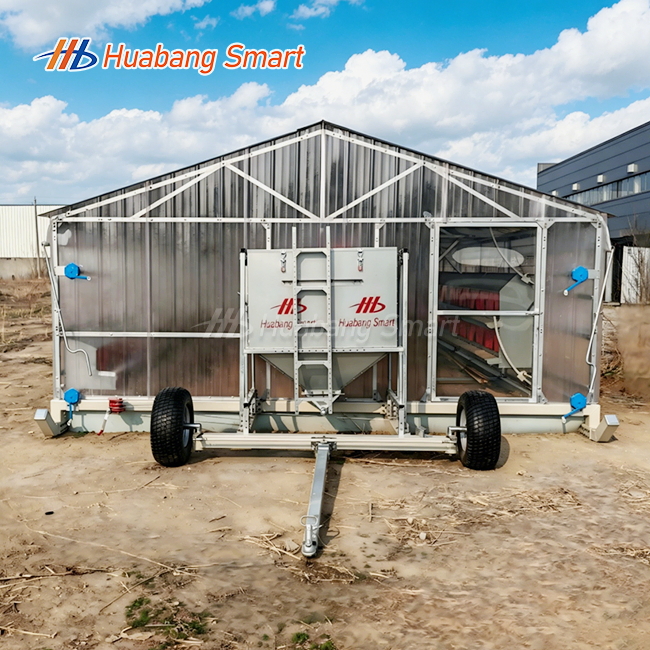 VIEW MOREMobile Chicken Coop Tractor With Wheels Nest Boxes
 VIEW MOREH Type 3 Tier Broiler Chicken Cage
 VIEW MOREChicken Cages Egg Layer H Type
 VIEW MORELayer Cages Egg Chicken Poultry Farm
 VIEW MOREAutomatic Chicken Broiler Cage